Here is a natural, native-sounding English translation of your text, adapted for the tone of a product design or tech blog:
When choosing a Skroutz Point, most of us think about which one is closest or most convenient. We rarely wonder if we’ll actually be able to reach the locker or open the compartment assigned to us.
For many people, however, this uncertainty is a given with every online purchase.
At Skroutz, we believe the pickup experience should be equally effortless and independent for everyone. And since our core principle as Product Designers is to design human-centric solutions, we started exploring how we could make Skroutz Points more accessible. Our goal was to empower our users to know in advance which locations have the right infrastructure and, if they wish, to request their order be placed in a lower locker compartment.
How the idea was born
The feedback came through our social media when a customer—a wheelchair user and member of the National Accessibility Authority—mentioned the difficulties he faced during his experience. This could have been contained to a simple customer support ticket, but we decided to investigate it as a Product Design Team.
“Accessibility cannot simply be stated in theory; it must be proven in practice. You can’t know if a location is accessible just from a list of features—someone actually has to go and see it. This is the main takeaway from my years at Google, initially as the Accessibility Ambassador for my team at Google Maps. Later, I worked at Google’s first Accessibility Centre in London, a space where you observe people with disabilities using what you’ve built, rather than just reading specifications.” — Giannis Nousis, Head of Product Design
Designing the solution
From the very beginning, it was clear that we didn’t want to create a separate, siloed experience solely for those who need it. Our goal was to integrate this information organically into the Skroutz Point selection process, without adding extra complexity for the rest of our users.
Perhaps the most interesting aspect of this project is that the data wasn’t generated theoretically.
We were fortunate to build upon valuable groundwork laid by our colleagues two years prior. They had evaluated the locations on-site, gathering data that was just waiting for the right moment to be integrated into the product.
The evaluation wasn’t limited to whether a ramp was present. Factors such as sidewalk access, the presence of stairs or other obstacles, the available space for wheelchair maneuverability, and overall whether someone could approach the spot safely and comfortably were all taken into account.
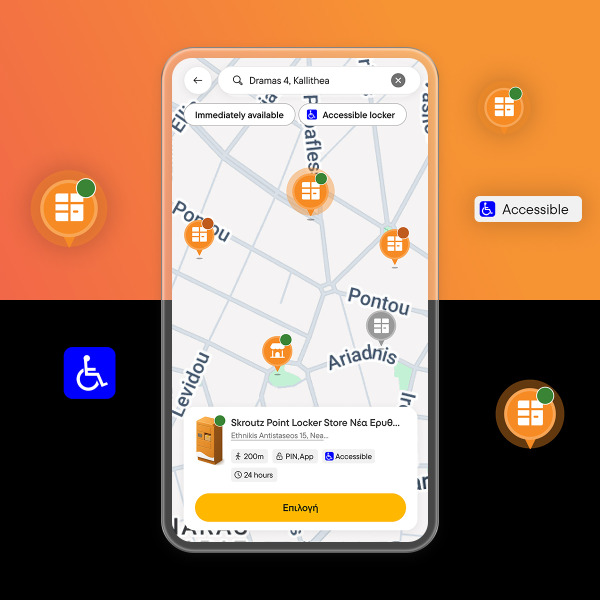
Unsurprisingly, the assessment showed that many of the accessible Skroutz Points were already located in areas with appropriate infrastructure, such as supermarkets, while at the same time, we continuously evaluate new points within our network.
However, no design decision can replace feedback from the people who will actually use the solution. That’s why we held a meeting with a Member of the National Accessibility Authority to discuss the design and the solution we had envisioned.
This process confirmed that knowing in advance whether a location is accessible significantly reduces uncertainty when choosing a delivery method. It was another reminder that accessibility cannot be designed solely from behind a screen. We need to discuss, observe, and test alongside the people who will actually use the solution.
“Regarding the final design, I made some choices that helped us take the feature even further. When selecting a Skroutz Point at checkout, we added an optional filter that displays only the accessible locations. The accessibility filter was integrated directly into the existing checkout flow, without discrimination or separate user journeys. At the same time, these points are marked with the International Symbol of Access so they are easily recognizable. Following that, the user can state their preference for having their parcel placed in a lower compartment. Although placement depends on the locker’s availability, these requests are processed with priority to ensure the pickup is as autonomous and effortless as possible.” — Vilma Fragkoulopoulou, Senior Product Designer
Accessibility is not a feature
This specific project was brought to life through the collaboration of multiple teams: Product, Design, Engineering, Operations, and Customer Support.
For us, however, the most important takeaway is that we took another step towards a product that works for more people.
Accessibility isn’t something that ends with a single release. It is an ongoing process of improvement, learning, and collaborating with people who experience everyday life differently than we do.
And we hope this is just the beginning.


